BULLY BOY PRESS & CEDRIC'S BIG MIX -- THE KOOL-AID TABLE
WAS 2013 THE WORST YEAR OF BARRY O'S PRESIDENCY?
NOT ACCORDING TO HIM.
WHICH MEANS WE SHOULD ALL SHUDDER AT THE THOUGHT OF HOW BAD THINGS WILL GET IN 2014!
FROM THE TCI WIRE:
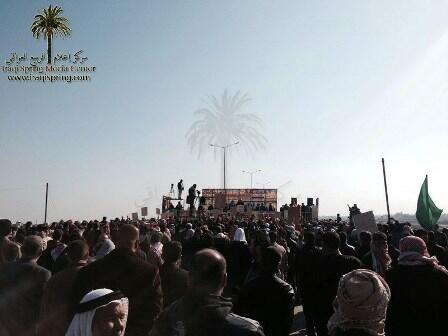
Today, protests took place in Iraq.
-
-
As Iraqi Spring MC notes above, the people turned out in Falluja.
To appreciate what took place today with regards to the protests, we
have to drop back to the wave of protests which took place in 2011.
Back then, the Arab Spring or 'Arab Spring' took hold in places in the
Middle East promising populism and freedoms. Even in areas where the
protests weren't put down, little changed. This week, a
young Iraqi woman told BBC News,
"I thought the uprising was a brighter future for our Middle East but
it turned out to be a huge failure because of other countries meddling
in our issues, it became a huge, huge failure for our Middle East I am
against these uprisings and I wish it never would have happened in the
first place."
Iraq's 2011 protests actually began before the 'Arab Spring.' What were they protesting in Iraq?
Corruption, the 'disappeared' (Iraqis rounded up and then lost in the
maze of what some optimistically call "justice" in Iraq), the lack of
jobs and a government that looked pretty much like the one before the
2010 elections -- despite Iraqis turning out to vote and putting Iraqiya
in first place.
An Iraqi correspondent for McClatchy explained one day's protests as follows:
The main purpose of the demonstrations
that took place in many Iraqi cities in Feb 25 was to give the Iraqi
officials an idea about the bad reality that we live eight years after
what was called liberation. After the collapse of the former regime in
2003, Iraqis were so optimistic about future. We thought that collapsing
Saddam's regime was the end of suffering, deprivation but it looks that
Iraq moved from the dictatorship of one party to the dictatorship of a
group of parties. Both Baath Party and the current Iraqi parties care
only about their interests neglecting Iraqis completely. During Saddam's
regime, high positions were only for the regime's supporters and now
the same thing happen. If you are not a member of the ruling parties or a
friend of one of the officials, you can forget about having a decent
job even if you have the highest level of education. Professionalism is
not the basic criterion in Iraq. It had been ignored more than three
decades ago. The basic criterion now days is (which party are you from?
)or sometimes (how much money you can pay to get the position?)
The Pacifica Evening News carried a report on the various protests Friday, February 25, 2011:
Mark
Mericle: Thousands marched on government buildings and clashed with
security forces in cities across Iraq in an outpouring of anger that
left 11 people dead -- the largest and most violent anti-government
protests in the country since political unrest began spreading in the
Arab world weeks ago. The protests, billed as a Day of Rage were fueled
over anger by corruption, chronic unemployment and shoddy public
services from the Sh'ite dominated government. Shi'ite religious
leaders discouraged people from taking part, greatly diminishing the
Shi'ite participation. Tarek Bazley reports.
Tarek
Bazley: The spirit of protest is very much alive in Iraq despite the
capitol and virtual security lockdown, thousands took to the streets.
Their day of rage inspired by recent events in North Africa.
Iraqi
man: Our demands are to prevent corruption by making laws to prevent it
and apply it correctly for the of the Iraqi people.
Tarek
Bazley: Soldiers searched protesters trying to enter Liberation Square.
They barricaded a bridge leading to the city's so-called Green Zone
government area. At one point, protesters threw stones at riot police
and forced them back against the wall. In the southern city Basra,
around 3,000 also took to the streets to protest against corruption and a
lack of basic services. Concrete slabs surrounding the Basra
government building were knocked over. Clashes too with riot police in
Mosul where provincial government offices were set on fire. Eight years
after the US invasion and the fall of Saddam Hussein, there's clear
anger on the streets. Development has been slow to come to the country
and after recent events in the region there are fears that anger could
drive a broader call for change. Tarek Bazley, Aljazeera.
In the face of those protests and with unrest elsewhere in the region
and the government of Egypt eventually toppled, Nouri got a little
worried. So what did he do? He started making promises.
Nouri's words always worthless, that's been established repeatedly. But
fearing for his own job, he promised that he would 'abdicate' his
'throne' at the end of his second term and that, if the protesters would
just stop protesting, give him 100 days, he would end corruption. His
lies were all about ending the protests.
Let's review some of that. Dropping back
to
February 5, 2011:
This week has seen a lot of words but not a lot of action. Words
include the announcement that Nouri won't seek a third term. Why does
it matter who he said it to?
Announced by who? The Los Angeles Times isn't clear. He said it to Sammy Ketz of AFP in an interview. Ketz reports
him stating he won't seek a third term, that 8 years is enough and that
he supports a measure to the Constitution limiting prime ministers to
two terms.
Of course, he didn't support a measure limiting the office to two terms.
In fact, last August, he was ordering the Baghdad court to nullify a
measure that the Parliament passed. But let's drop back now to
February 6, 2011 where we again noted Nouri's claim reported by Sammy Ketz:
That was written yesterday and Nouri couldn't even go 24 hours sticking to his 'promise.' Ben Lando and Munaf Ammar (Wall St. Journal) report
that Nouri's spokesperson, Ali al-Mousawi, declared today, "We would
like to correct this article. Maliki said, 'I think that the period of
eight years is adequate for the application of a successful program to
the prime minister, and if he is not successful, he must vacate his
place'." Of course he's not announcing that. He's a thug. His
previous four year term was an utter failure.
In March (2011), the
New York Times' editorial board's "
Mr. Maliki's Power Grab" showed more sense than many outlets like the BBC had:
Instead of taking responsibility, Mr.
Maliki charged that the protests were organized by "terrorists." He
ordered the closing of the offices of two political parties that helped
lead the demonstrations.
His
only concessions were vows not to seek a third term in 2014 and to cut
his pay in half. That was not persuasive, especially given his many
recent power grabs.
Again, Nouri's word is worthless. He established that repeatedly in his
first term and repeatedly in his second. He cannot be trusted, his
word is meaningless. Now he wants a third term despite his promises.
What about those 100 days?
Dropping back to the
June 7, 2011 snapshot:
The 100 days is over. Al Rafidayn reports
Nouri's press conference yesterday in Baghdad found Nouri expressing
his hope that "the citizens will treat us kindly in the measuring our
accomplishments and that they will be objective." He announced that
meetings would take place today on evaluations. New Sabah quotes
State Of Law's Khaled al-Asadi stating that Nouri will make assessments
through tonight and that the 100 Days was in order to evaluate the
performances and that "no sane person would assume a government only
four years old could accomplish improvement in one hundred days." Oh,how
they try to lower the expectations now. The 100 Days? Al Jazeera gets it right,
"Maliki gave his cabinet a 100-day deadline to improve basic services
after a string of anti-government protests across Iraq in February. He
promised to assess their progress at the end of that period, and warned
that 'changes will be made' at failing ministries. That deadline
expired on Tuesday -- and Maliki largely retreated from his threat,
instead asking for patience and more time to solve problems." Fakhri Karim (Al Mada) observes
that the 100 Days has done little to instill strength in the belief
that Nouri has the "ability to manage the Cabinet" and the duties of the
office of prime minister. Karim notes that Nouri's inability to govern,
his failure at it, led to the protests and that they were for the basic
services which are "the most basic necessities" of our time. Alsumaria TV notes,
"Starting today, meetings will be held in front of the people.
Discussions will cover all fields one by one. We will go over three
headlines or three ministers. We must realize the framework upon which
we will carry on with the second 100 day deadline, Maliki said."
Please, Nouri lied to end the protests. There was no end of corruption
at the end of 100 days. Just more lies from Nouir. His assertion of
"the second 100 day deadline"? What a load of crap. There was never
another mention of ending corruption let alone the open hearings and
meetings he claimed would take place.
He's just a cheap little thug who will say anything to maintain his hold on power.
During the 100 days most of the protesters stopped protesting. Some
because cleric and movement leader Moqtada al-Sadr urged them to stop.
The protests would try to regroup after June 7th. Some would take part
in the protests but it did not reach the level that it had been in
February 2011. There were reasons for that, such as the attacks on the
protesters, the assassination of journalist and activist
Hadi al-Mahdi (assassinated
on Nouri's orders, I will always believe) and more. But regardless of
the reasons, the protests had lost their momentum.
Today, Iraqi Spring MC reports protests also took place in
Ramadi,
Samarra,
Jalawla,
Tikrit, among other places.
And this matters because protests matter.
But it matters also because of what it demonstrates about the Iraqi people.
What I'm offering is my opinion, my analysis. I can be wrong. Anyone
can be and I'm more often wrong than most people, I'm sure. But I do
know politics and that includes certain signs.
There what the press repeatedly missed.
To establish that, we'll just use one example. December 30th, Sunni
politician and Iraqi Deputy Prime Minister Saleh al-Mutlaq tried to
grand stand and use a Ramadi protest as a photo op. That rocks and
bottles were tossed at him was shocking to the western press. Just
shocking. He's so popular! He's so loved! The calendar showed 2012
was winding down but the press was living in 2010. As I noted on
December 30th:
Why he was stupid enough to go to a protest is beyond me. Yes, he is
Sunni and, yes, he is in the Iraqiya slate. But Saleh al-Mutlaq is not
popular. He and Vice President Tareq al-Hashemi (also Sunni and
Iraqiya) were both targeted by Nouri in December of 2011. While Tareq
ended up having to leave the country and being convicted of 'terrorism,'
Saleh sailed right through. In May, Nouri dropped his efforts to strip
Saleh of his office.
By that point, there had been months of speculation in the Iraqi press
that Saleh al-Mutlaq had cut a deal to save his own ass, that he was now
in partnership with Nouri al-Maliki. This seemed to be even more true
when Saleh was seen as undermining efforts to get a no-confidence vote
against Nouri as spring was winding down.
Saleh al-Mutlaq is seen -- rightly or wrongly -- by Sunni Iraqis as
someone who protects himself and does nothing for other Sunnis (whether
they're politicians or average citizens).
He went to a Sunni area, Ramadi, where protests had long been taking
place and was immediately greeted with a demand that he resign from the
Cabinet. (That would not have taken him out of his MP status. He just
would no longer be a Cabinet member.) He was appalled by the idea and
rejected it outright.
Nouri's first term was notorious for one Cabinet walk out after another.
But Saleh wouldn't even entertain the idea?
You've got provincial councils going on strike but Saleh can't even do a walk out?
Of course they threw rocks and bottles at him. He was already seen as a
sell-out. And people want to believe that's not the case but then he
appears before them and acts like that? He destroys his own image.
He never should have gone and it's a sign of just how out of touch with Sunni public opinion he is that he did show up.
It wasn't just that they played dumb in their press reports in real
time. It was also that my take above resulted in four members of the
press -- one wire service, three US newspaper 'men' (all contacting were
men -- they're always so eager to 'correct' a woman) . If you ever
wanted to be quoted, just note in your e-mail that you want to be named
and quoted.
Of course, it's good that you didn't want to be noted.
Salah al-Mutlaq popped up at the protests again.
At the end of March. Not physically. It was his image. People
carried his image. But before you think like the western press -- "Oh,
that popular Saleh!" -- take a look at what they carried.
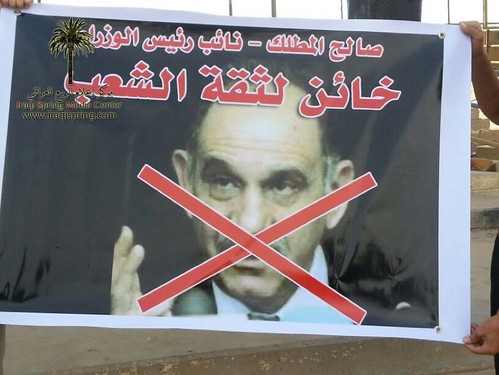
I don't think you need to speak Arabic to grasp what the big red X across his face means.
Three months before, we'd already talked about the realities -- realities the western press denied.
So I can be wrong, I often am wrong. But I can also be right and I feel right about what I'm going to offer below.
People are fretting that the vote -- if parliamentary elections take
place on April 30th -- will be lower than in 2010 and it will be
especially lower for Sunnis. Some western commentators are insisting
that Sunnis will stay home.
They're basing on a see-saw that's been present so far.
In the 2005 parlimentary elections, Shi'ites turned out in large numbers
while Sunnis -- in significant numbers -- didn't vote. In 2010, the
reverse was true.
Based on that pattern, it is probably safe to predict that the next election will see Sunnis disenchanted and staying home.
But what about the pattern of today?
December 21, 2012,
this wave of protests kicked off. Today, they reached the one year mark.
Iraqis -- largely Sunni, but not just -- carried on a wave of protests
for one year -- and counting. Today, was the one year mark but there's
not any announcement that they stopped today.
For one year, they've protested. Largely Sunnis, protesting in spite of everything.
Nothing has stopped them.
The
flooding in Iraq didn't stop them.
The increased violence in Iraq didn't stop
them.
Being targeted with threats and violence didn't stop them.
While many western outlets published stories about poor little back
stabbing Saleh getting pelted and used that as 'violent protests!,' the
same outlets ignored the ongoing violence aimed at the protesters.
Such as?
January 7th, Nouri's forces assaulted four protesters in Mosul,
January 24th, Nouri's forces sent two protesters (and one reporter) to the hospital, and
March 8th, Nouri's force fired on protesters in Mosul killing three.
All of that and more appeared to be a trial run for what was coming, the
April 23rd
massacre of a peaceful sit-in in Hawija which resulted from Nouri's federal forces storming in.
Alsumaria noted Kirkuk's Department of Health (Hawija is in Kirkuk) announced 50
activists have died and 110 were injured in the assault.
AFP reported the death toll rose to 53 dead.
UNICEF noted that the dead included 8 children (twelve more were injured).
Not even that attack stopped the protests.
RECOMMENDED: "
Iraq snapshot"
"
The ongoing protests hit the one year mark"
"
9100 violent deaths in Iraq so far this year"
"
Nikita -- 2nd to last episode"
"
A few thoughts"
"
jane fonda needs professional help"
"
F**k you bitches of Jezebel (NSFW)"
"
Wolverine"
"
My Christmas present?"
"
Bitch boi CCR (Center for Constitutional Rights)"
"
For those who saw the bulls**t at Ms. . . ."
"
They still itch for war with Syria"
"
Barack's treatment of immigrants"
"
They've got a fan"
"
THIS JUST IN! THE FAN BOY SPEAKS!"
 Barack Obama
 اعلام الربيع العراقي



 Alastair Macdonald